

As an annual plant belonging to the madder family (Rubiaceae), catchweed bedstraw occasionally germinates in autumn and overwinters, but its leaves typically emerge in early spring. Initially, the stems spread out in all directions as if crawling along the ground, but they later grow upward to form dense, tangled thickets. At each stem node, 6 to 8 leaves grow in a whorled pattern, and the fruits feature hooked hairs at their tips that allow them to cling to animal fur for dispersal.
Catchweed bedstraw (Galium spurium var. echinospermon) is an annual plant belonging to the madder family (Rubiaceae). It commonly grows in agricultural fields, orchards, vacant lots, roadsides, and forest edges. In the southern regions of Korea, it occasionally germinates in autumn and overwinter, but its leaves typically emerge in early spring. Initially, the stems spread outward in all directions as if crawling along the ground, but they eventually grow upright to a length of 60 to 90 cm, forming dense, tangled thickets.
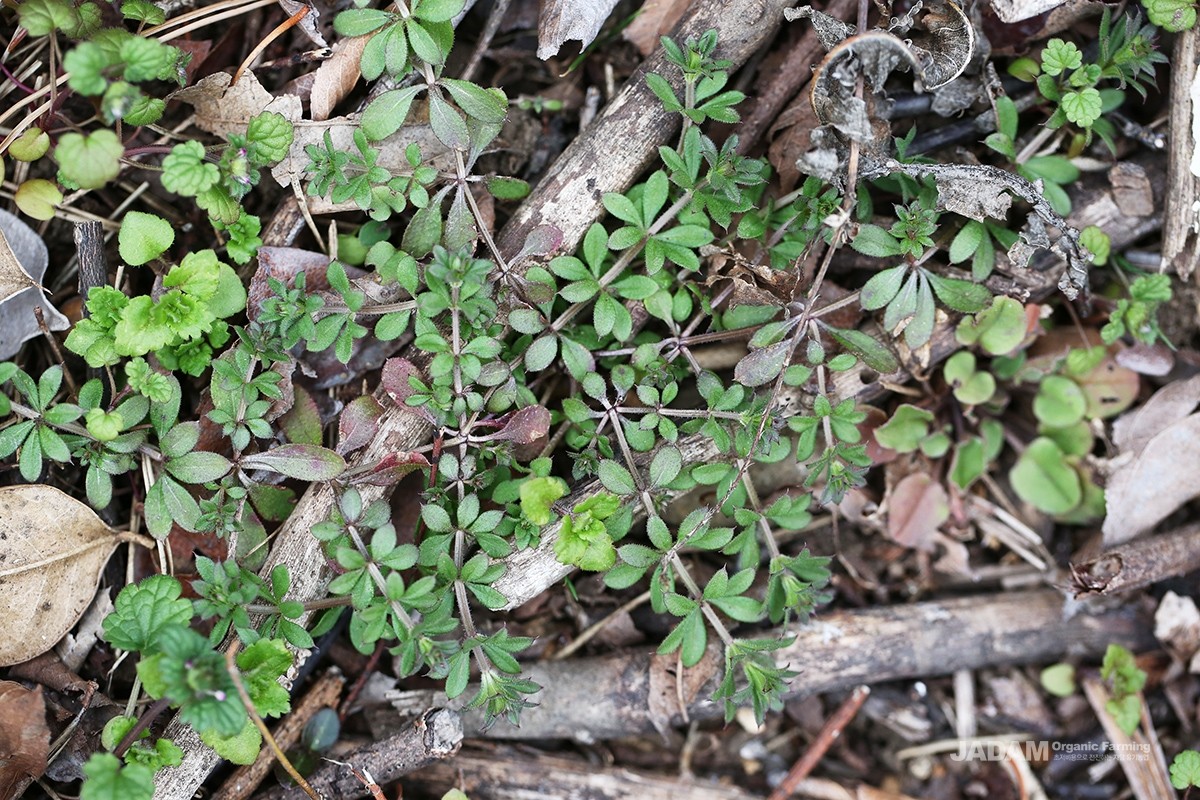
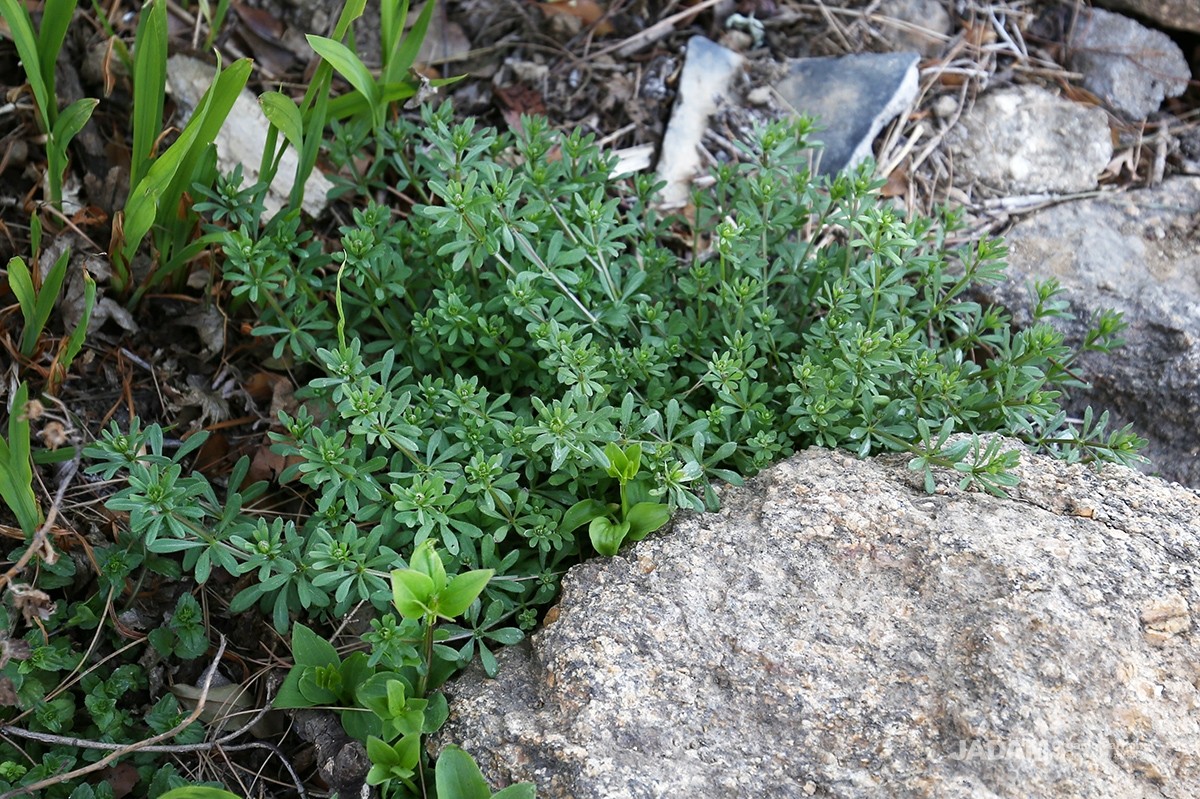
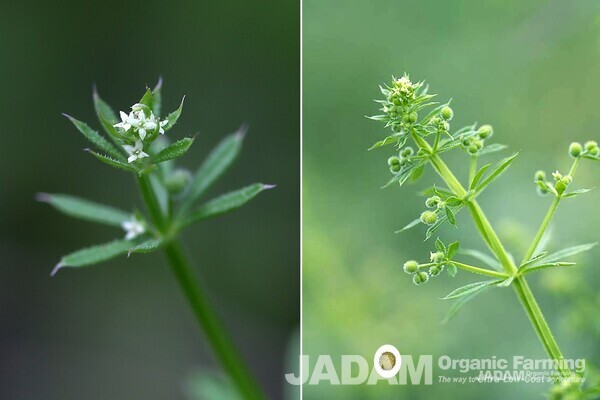
The stems are distinctly square-shaped with fine, downward-pointing prickles along the ridges. At each stem node, 6 to 8 leaves grow in a whorled pattern. The leaves are narrowly oblanceolate (reverse lance-shaped), measuring 2 to 4 cm in length and 2 to 5 mm in width, with sharp, spine-like tips. The midrib is prominent, the upper surface is rough to the touch, and fine, downward-pointing prickles line the margins and the main vein on the underside. Using these prickles on its stems and leaves, the plant can hitch onto and climb over neighboring vegetation much like a climbing vine.
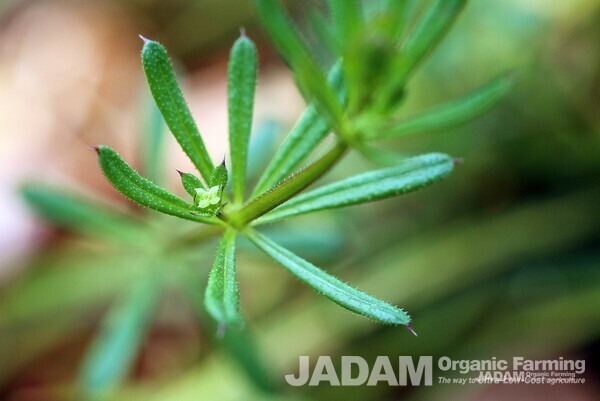
From April to June, yellowish greenish-white flowers bloom in cymes from the leaf axils on the upper parts of the stem. These flowers are exceptionally tiny, measuring a mere 1 to 1.5 mm in diameter. Each flower features four petals, four stamens, and a style split into two. Attached right below the flower are two spherical ovaries densely covered in white hairs. Once the flowers fade, the hairs on the ovaries harden into hooked bristles, and they mature into slightly succulent fruits.
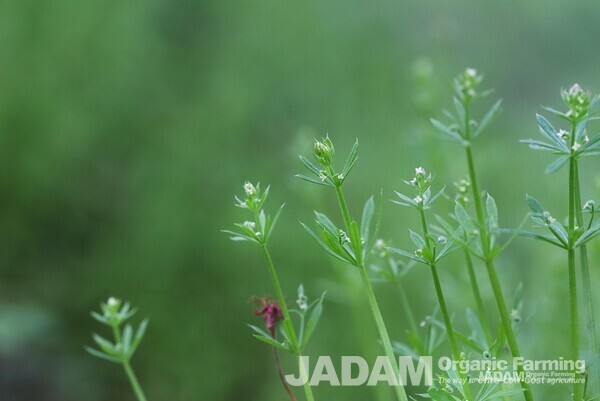
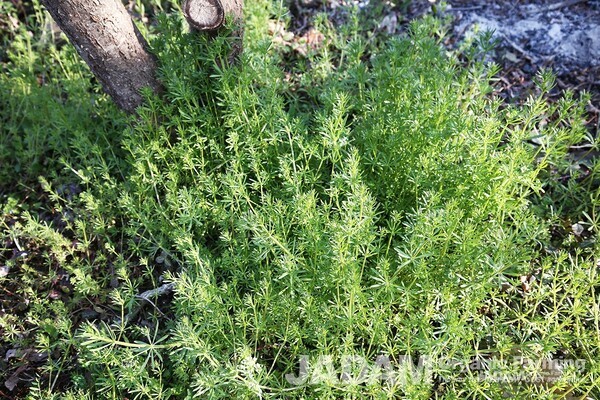
As summer arrives, the above-ground parts of the plant slowly wither away while still bearing fruit. The fruits are heavily armored with hooked hairs, allowing them to cling tightly to the feathers of small foraging birds, the fur of passing animals, or human trouser legs to disperse over long distances. Although its flowers and fruits are inconspicuously small, its highly evolved strategy for animal-mediated seed dispersal is just as effective as that of cocklebur or beggarticks.
Uses and Medicinal Properties
The young shoots of catchweed bedstraw are blanched and consumed as namul (Korean seasoned herbal dishes), while the whole plant can be layered with sugar to create hyoso (fermented plant enzyme extract).
In traditional herbal medicine, it is used to clear damp-heat, disperse blood stasis, reduce swelling, and detoxify the body. It is often prescribed for conditions such as strangury (painful, trickling urination), hematuria (blood in urine), bruises, intestinal abscesses, edema, and otitis media (middle ear infection). Additionally, it has shown efficacy in managing symptoms associated with breast cancer, esophageal cancer, cervical cancer, and parotitis (mumps). The herb is bitter and pungent in taste and possesses a cold nature.
Control Methods
While catchweed bedstraw does not pose a major threat in open orchards, it should be thoroughly eradicated at the beginning of the farming season if it invades agricultural fields or greenhouses.
Name Origin and Similar Species
The plant is natively called galqui-deonggul (meaning rake vine) because its whorled leaf arrangement resembles a hand rake, and its stems stretch out like vines. It is easily distinguished from similar species like the four-leaf bedstraw, which typically features only four leaves per whorl, by its arrangement of six or more leaves per node and the fine, downward-pointing prickles running along its stem.
FAQ: Quick Fact
Q: Is catchweed bedstraw edible, and what are its main characteristics and medicinal benefits?
A: Yes, the young shoots are edible when blanched. Characterized by square stems covered in tiny hooked prickles that allow it to climb like a vine, catchweed bedstraw is utilized in herbal medicine to reduce swelling, detoxify the body, and clear blood stasis.