

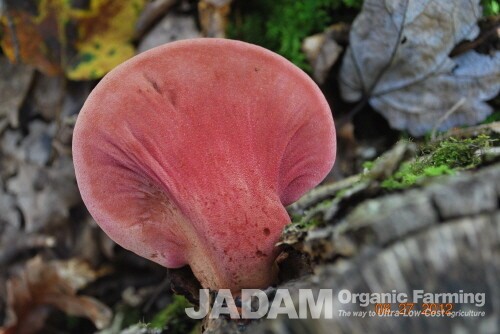
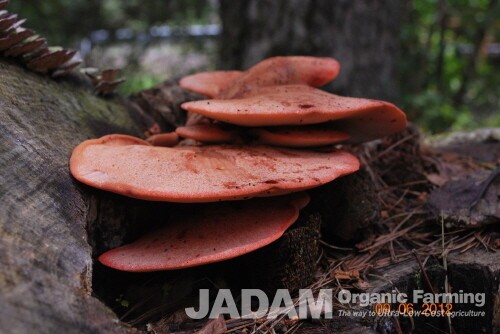
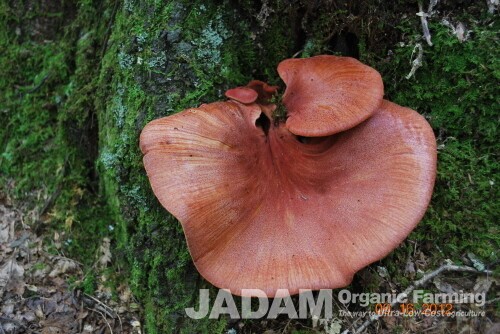
Fistulina hepatica (Schaeff.) With. The English common names are many and varied: beefsteak fungus, poor man's beefsteak, the jelly fungus, beefsteak polypore, and ox-tongue, among others.
The genus name Fistulina means "hollow, shaped like a pipe," while the species name hepatica was given because the mushroom's form and tissue resemble a liver—in Greek the word means "liver-like." The English name beefsteak comes from the look of its flesh and the red liquid it exudes, which together resemble a cut of red beef. And although ox-tongue is one of the common English names, when all is said and done it is our Korean name—so-hyeo-beoseot, literally "ox-tongue mushroom"—that captures the shape of this fungus best of all.
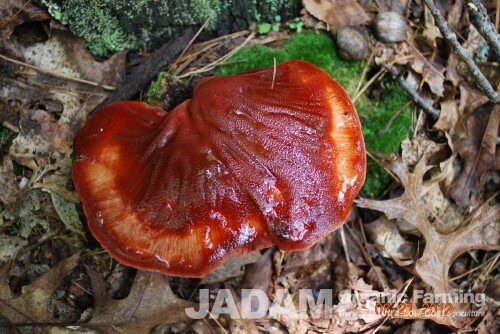
You can slice it raw into a vegetable salad, and I myself have tried eating it a piece at a time wrapped in lettuce (ssam, a Korean leaf wrap)—the taste is quite good. David Arora, who has published an enormous mushroom field guide, says he slices the beefsteak fungus thin and stores it marinated in seasoned vinegar and olive oil. It does, however, have a strong sour taste. For that reason it suits dishes that would otherwise call for lemon, and because it contains a compound that tenderizes meat, it is also used in meat cookery. Its sourness keeps insects from eating it. Cooked, it takes on the texture of liver—just as the species name hepatica, "liver-like," suggests. Like meat, most mushrooms contain no vitamin C, but the beefsteak fungus alone is said to hold 150 mg of vitamin C per 100 g—five times the recommended daily requirement for a human being.
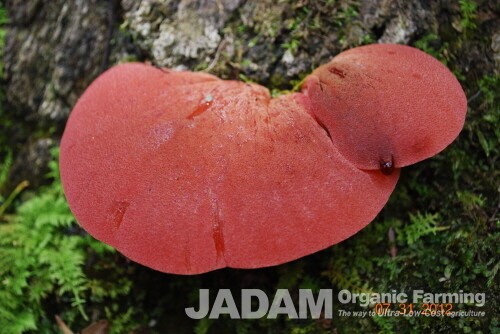
This mushroom grows mainly on dead oak and chestnut trees, and even on living oaks, making it something of a semi-parasite on living oak. It therefore causes heartwood decay in oak, though the rotting process is very slow. As it works, and before the oak has fully decayed, it turns the heartwood a mottled reddish-brown; the resulting "brown oak" is said to be highly prized by the carpenters who build kitchen cabinets. Dried and powdered, the beefsteak fungus can also be used as a natural dye, coloring wool and other animal fibers and silk a beige or grayish-brown.
In the summer of 2012 it appeared in unusually large numbers compared with other years, and I came across it almost everywhere I went. It seems to be relatively uncommon in Korea; since China is now attempting to cultivate it commercially, perhaps we in Korea might try growing it artificially as well.
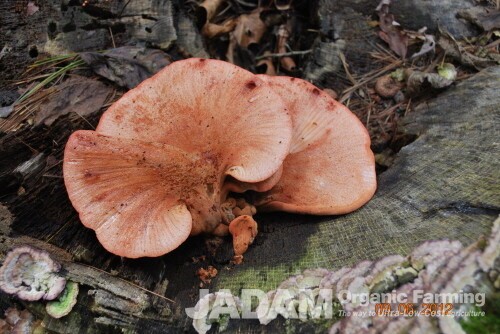
Medicinal Uses of the Beefsteak Fungus
In old Ireland, it is said, the beefsteak fungus was laid over chronic, stubborn skin ulcers as a treatment. Extracted with hot water at a melting point of 230–260°C, the fungus can be reduced to a grayish-white powder; this extract contains gelatose, xylose (wood sugar), and arabinose. A water extract of the beefsteak fungus has shown a 95% inhibition rate against Sarcoma 180 cancer cells and a 90% inhibition rate against Ehrlich ascites carcinoma.
The beefsteak fungus also contains two antibacterial compounds, cinnatriacetin A and B. In 1981, Coletto and colleagues found compounds in its mycelium active against Escherichia coli, Staphylococcus aureus, and Bacillus subtilis, and in 1992 they identified a compound active against Klebsiella pneumoniae. As early as 1945, an agent inhibiting Staphylococcus aureus had already been found in the fruiting body of this fungus.
In 1973, Farrell and colleagues discovered in the beefsteak fungus a naturally occurring acetylene—an antibacterial compound similar to the penicillin-class antibiotic cephalosporin C—active against Staphylococcus aureus and Salmonella typhi.
The beefsteak fungus contains ellagic acids (49.7%), which slow the growth of cancer cells, and nearly 58% of the organic acid malic acid. Beyond this, researchers have found compounds with strong antioxidant activity that also inhibit xanthine oxidase, an enzyme acting on nitrogen compounds found in blood, urine, and the liver. If so, the beefsteak fungus may well be a mushroom useful in treating gout and arthritis.
The Essential Oil of the Beefsteak Fungus
The beefsteak fungus contains many volatile compounds responsible for its aroma, sweetness, and scent of wildflowers. Among them are 1-octen-3-one and 1-octen-3-ol; linalool, used in perfumes; phenylacetaldehyde, which has a hyacinth-like fragrance and is used mainly in perfume; butanoic acid; (E)-2-methyl-2-butenoic acid; (E)-methyl cinnamate; (Z)-9-hexadecenoic acid; methyl ester, also used as a fragrance; bisabolol oxide B; and phenylacetic acid.
References:
Park Wan-hee and Lee Ho-deuk, Field Guide to Korean Medicinal Mushrooms, Seoul: Kyohak-sa, 1999 (1st ed.), 2003 (2nd ed.), pp. 647, 564.
Robert Rogers, The Fungal Pharmacy: The Complete Guide to Medicinal Mushrooms and Lichens of North America, Berkeley, Calif.: North Atlantic Press, 2011, pp. 140–141.
FAQ: Quick Fact
Q. Is the beefsteak fungus edible, and what is it known for?
A. Yes—it is an edible bracket fungus that grows on oak and chestnut, eaten raw in salads or cooked (when it takes on a liver-like texture), though it has a markedly sour taste. It is notable for an exceptionally high vitamin C content and has been studied for antibacterial, antioxidant, and tumor-inhibiting compounds. It also yields "brown oak" timber prized by woodworkers and serves as a natural dye.