

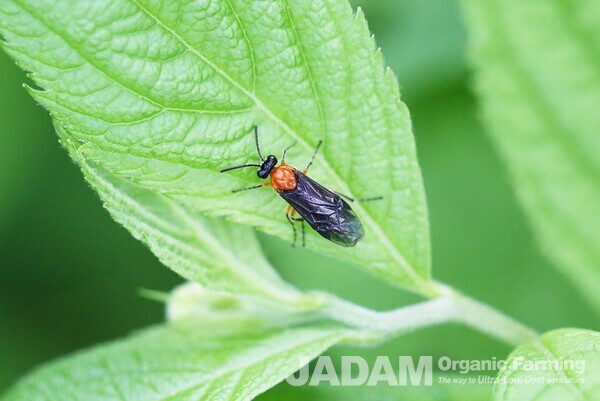
The larvae of the turnip sawflies primarily feed on Brassicaceae plants, including radishes, turnips, napa cabbage, bok choy, broccoli, and rapeseed. The turnip sawfly larva is entirely murky gray and features many transverse wrinkles. The adult is about 5 to 7.5 mm long, with a black head and antennae, an orange thorax and notum, and a yellow abdomen
The mustard sawfly (Athalia proxima) is a small sawfly species measuring about 5 to 7.5 mm in body length. Its head, antennae, tibiae, and tarsi are black; its thorax, notum, and femora are orange; and its abdomen is yellow. The forewings are an opaque gray, appearing black when folded over each other. In addition to the mustard sawfly, Korea is home to several related species, including the turnip sawfly (Athalia rosae), the Japanese turnip sawfly (Athalia japonica), the pale turnip sawfly, the sharp-tipped turnip sawfly, and the eastern turnip sawfly (Athalia infumata).
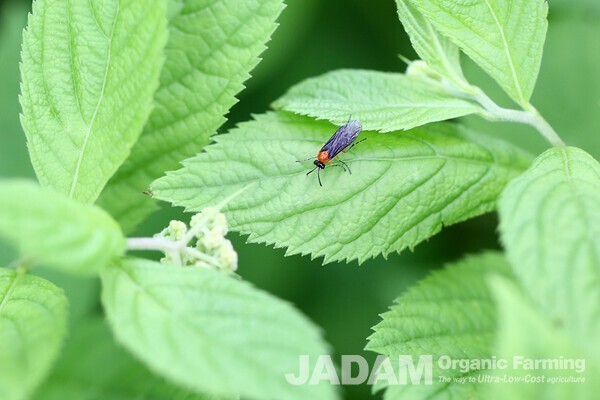
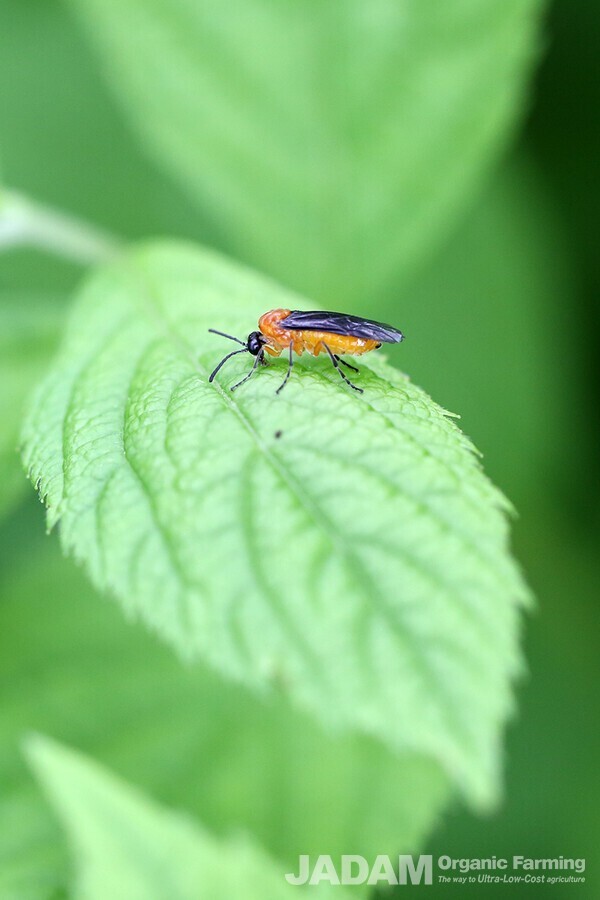
Although they are classified as sawflies, they belong specifically to the Athalia genus because their larvae primarily feed on Brassicaceae crops such as radishes, turnips, napa cabbage, bok choy, broccoli, and rapeseed. The Athalia larvae overwinter in the soil, go through a short pupal stage, and emerge as adults in early May. Within a few days, they mate and lay eggs under the epidermis on the undersides of the leaf margins of their host plants.
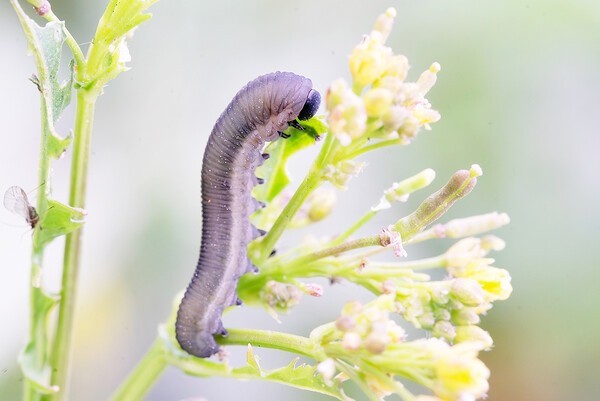
The oviposition sites swell slightly, and the eggs hatch into larvae after one to two weeks. The turnip sawfly larva is entirely murky gray with many transverse wrinkles. When fully grown, it reaches about 15 to 20 mm in length. On early mornings and cloudy days, it hides on the undersides of leaves, but on clear days, it climbs to the upper surfaces of the leaves to feed. It eats starting from the margins of the leaves, and in severe cases, only the thick veins remain bare.
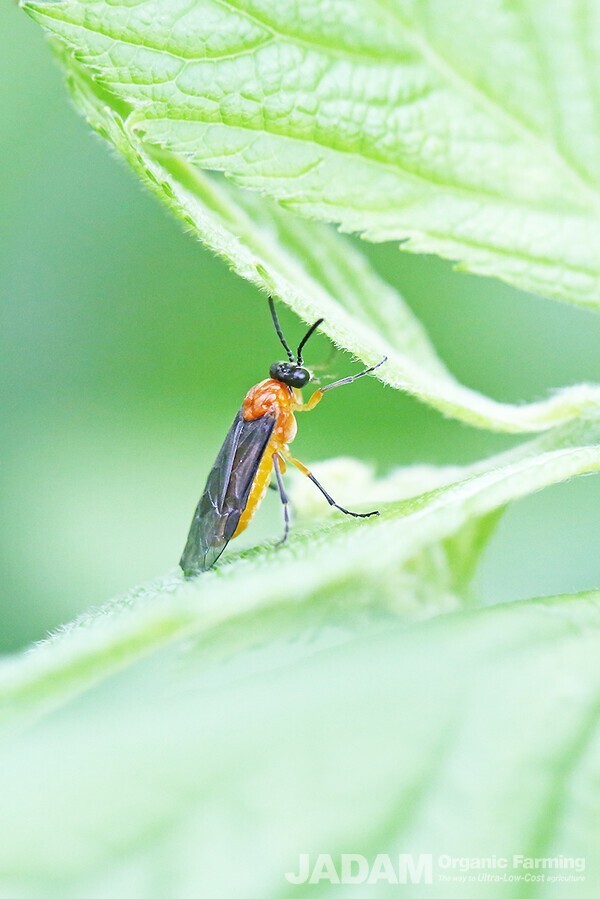
When the larva senses danger, it exhibits a defensive habit of rolling its body into a ball and dropping to the ground. After 10 to 20 days, the larva completes its development, enters the soil, and becomes a pupa. The second generation of adults appears from mid-June to mid-July, and the third generation emerges from mid-to-late September. Damage caused by the larvae is particularly severe in the autumn. The agricultural damage can be mitigated by thinning the crops to improve ventilation or by covering them with insect netting to prevent the adults from laying eggs.
FAQ: Quick Fact
Q: What is the mustard sawfly, and how does it impact agricultural crops?
A: The mustard sawfly is a small insect whose gray, wrinkled larvae are notorious agricultural pests that aggressively feed on the leaves of Brassicaceae crops—such as radishes, cabbages, and broccoli—often stripping them down to their bare veins, especially during the autumn season.