

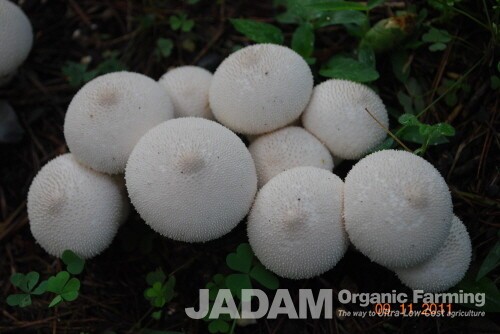
Common puffball (Lycoperdon perlatum Pers.)
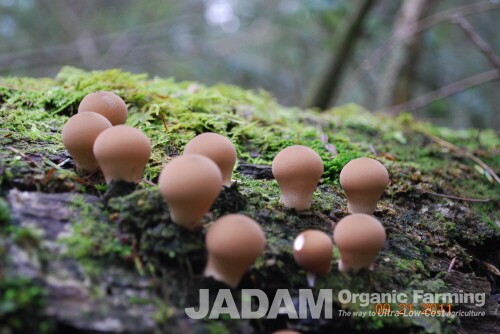
Pear-shaped puffball (Lycoperdon pyriforme Schaeff.)
Skull-shaped puffball (Calvatia craniformis (Schw.) Fr.)
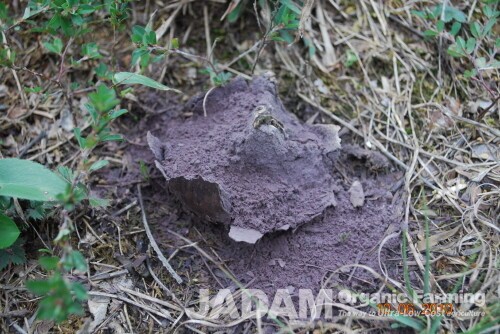
Purple-spored puffball (Calvatia cyathiformis (Bosc.) Morg.)
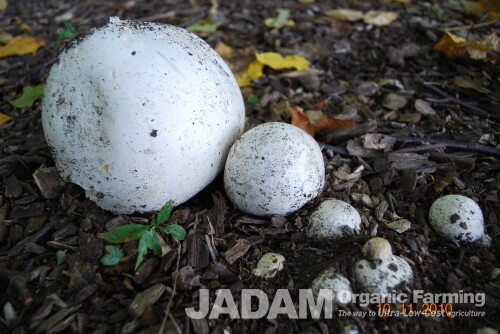
Giant puffball (Calvatia gigantea (Bat.: Pers.) Llyod)
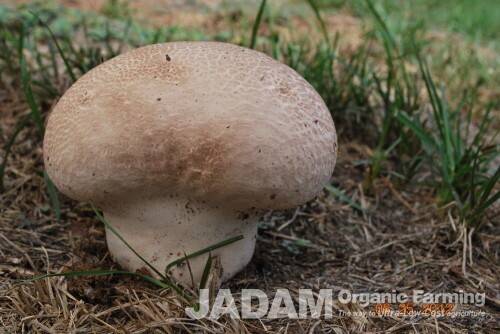
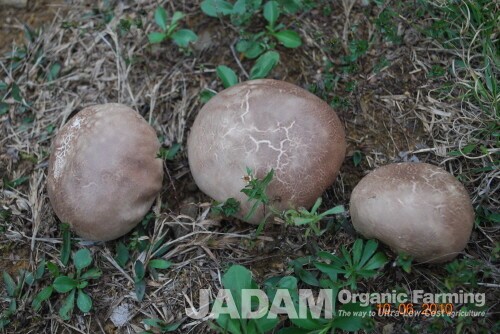
As seen in the list above, there are quite a few types of large and small, round, white mushrooms that sprout on the ground or on dead wood. Among them, the ones listed above are the most common and easily accessible, and all of them are edible in their immature, solid-white stage. They vary greatly in size, ranging from the size of marbles that children play with to the size of a typical soccer ball. A remarkably large specimen, discovered in New York State in 1877, was recorded as having a diameter of 162.5 cm. More recently, in 1987, a specimen discovered in Canada exceeded 2.5 meters in diameter and weighed a staggering 216 kg. Because they can grow so large, they are commonly known as giant puffballs in English, while in Korea, they are usually called daenggual-beoseot.
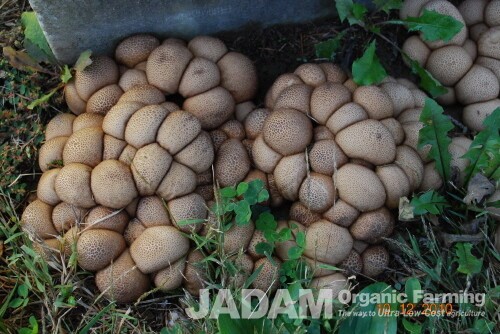
The spore count of the massive giant puffball discovered in Canada was estimated to be roughly 10^25. I have personally seen several of these mushrooms, about the size of soccer balls, growing together in a cluster. A giant puffball weighing just 250g typically produces about 7 trillion spores. If all these spores were to germinate and grow to the size of a soccer ball, it is calculated that their combined volume would be nearly 800 times larger than the Earth. When the smaller, marble-sized common puffballs or pear-shaped puffballs mature, a single raindrop hitting them during a shower can cause them to release a million spores into the air in an instant.
The genus name Lycoperdon, which applies to puffballs that grow on the ground, comes from the Greek words meaning "wolf's flatulence" or "the wind made by a wolf charging." The species name perlatum means "widespread." This name likely describes the way spore dust billows out like smoke and spreads far and wide when you tap a mature puffball with a stick. Additionally, the species name pyriforme for the pear-shaped puffball, which grows on dead wood, means "pear-shaped." These mushrooms are edible when they are firm and purely white inside. The inner flesh of the giant puffball looks exactly like tofu, and when fried, it is said to taste just like fried tofu.
Legends and Folktales Surrounding the Puffball
In ancient times, this mushroom was believed to be connected to the planet Jupiter and was associated with wisdom, nobility, and sincerity. In India, small puffballs were believed to be connected to thunder and lightning and were thought to possess souls. Various indigenous tribes used this mushroom as tinder to start fires, or dried it to use as incense during religious ceremonies to ward off evil spirits. For this reason, it was called "no-eyes" or "ghost's make-up." Round puffballs were also strung on a cord and worn around the neck as magical ornaments, and the hard-shelled varieties were filled with seeds or small pebbles to be used as rattling instruments. Thus, shamans and magicians used puffballs for various purposes.
Traditional Medical Uses
Traditionally, different Native American tribes used the spore dust of the puffball to stop bleeding and prevent infection by applying it directly to wounds. The soft, inner flesh of immature puffballs was also used to remove foreign objects from the eyes. Specifically, the Blackfoot tribe called the puffball "kakatoosi" (fallen stars) and viewed it as a harbinger of supernatural events; they also used the flesh of the immature mushrooms to extract debris from the eyes. In ancient Greece, this mushroom was reportedly used for the same purpose. It is said that mixing the dried powder with spiderwebs creates an even more effective hemostatic agent. The Blackfoot Indians also believed that drinking an infusion made from the spore dust prevented internal and severe hemorrhaging. The Blood tribe boiled puffballs in water, mixed them with oil, and used the concoction to treat infectious skin diseases like ringworm and hemorrhoids; they also held immature puffballs to their noses to stop nosebleeds.
Further north, the Chipewyan Indians of northwestern Canada used puffball spore powder to prevent diaper rash in babies. Various other tribes applied the spore powder not only for nosebleeds but also to treat skin rashes around the neck, ear infections, and the umbilical cord after it was cut. These traditional folk remedies, regardless of whether in the East or West, involved mixing the powder with oil or vinegar and applying it to inflamed areas or using it to stop bleeding. In China, it was specifically mixed with honey and used to treat throat inflammation, coughs, tonsillitis, laryngitis, and to regulate menstruation (Hobbs, 1996; Rogers, 2011). According to Professor Park Wan-hee, giant puffballs and common puffballs possess hemostatic, anti-inflammatory, and antifungal properties, and are used in traditional Korean medicine for colds, coughs, sore throats, external bleeding, and tonsillitis. The skull-shaped puffball also has antitumor, antibacterial, and antifungal properties and is similarly used for coughs, sore throats, and external bleeding (Park & Lee, 1999).
For centuries, European doctors have used spore powder as a highly effective hemostatic agent. Puffball infusions or tinctures were used as a gargle for sore throats. They were also used to stop bleeding from the lips or gums. In this way, it has been used externally for nosebleeds, skin ulcers, and oozing frostbite.
Modern Medical Uses
Chemical Composition: An analysis of the ashes of a burned giant puffball reveals 72% sodium phosphate, 16% aluminum, 3% magnesium, 0.44% organic silicic acid, and trace amounts of gold. The spores contain high levels of amino acids, urea, ergosterol, calvacin, and lipids. Common puffballs contain zinc, copper, lead, high levels of iron, and magnesium. Depending on the species, calvacin, which inhibits the proliferation of breast cancer cells, has been shown in mouse experiments to suppress Sarcoma 180, breast cancer, and leukemia. Mushrooms in the puffball family have high antibacterial properties and inhibit various types of bacteria.
In modern medicine in China, giant puffball spores were reportedly used successfully to stop bleeding in 98% of 467 surgical patients. Furthermore, the molecules of the giant puffball are effective against polio and influenza viruses. The pear-shaped puffball also contains antitumor components, showing a 100% inhibition rate against Sarcoma 180 and Ehrlich tumors, and it is also said to possess antifungal properties.
Recipes and Dosage
▶ Spore Powder: Mix 1-2g with honey and use as needed.
A mask should be worn when collecting spore powder.
▶Mushroom Infusion: Steep 2-6g of dried immature puffballs in tea
and drink as needed.
▶Decoction: Wrap dried puffballs in a cloth and boil for 20-30 minutes
before using.
▶Tincture: Use 5-10 drops as needed. Finely chop dried puffballs and
saturate them in 70% alcohol. Filter at a ratio of 1 part mushroom
to 5 parts saturated solution, and let it steep for two weeks
before bottling (Rogers, 2011).
▶For Wounds: Apply an appropriate amount of spore powder directly to
the wound.
▶For Coughs and Colds: Boil 6g of puffball and 3g of licorice in water, and
take twice a day.
▶For Chronic Tonsillitis: Boil 3g of puffball, 9g of Asiatic cornelian cherry,
and 6g of licorice in water, and take three times a day.
▶For Gastric Bleeding: Boil 6g of puffball in water, add honey or sugar,
and take twice a day (Park & Lee, 1999).
FAQ: Quick Fact
Q: Are puffballs edible, and what are their traditional and medicinal uses? A: Puffballs are edible when their inner flesh is purely white and firm; medicinally, their spore powder has been used globally for centuries as a powerful hemostatic agent to stop bleeding and treat wounds.
References
Hobbs, C. (1996). Medicinal mushrooms: An exploration of tradition, healing, & culture (3rd ed.). Interweave Press.
Park, W., & Lee, H. (1999). Korean medicinal mushrooms field guide. Kyohaksa.
Rogers, R. (2011). The fungal pharmacy: The complete guide to medicinal mushrooms and lichens of North America. North Atlantic Press.