

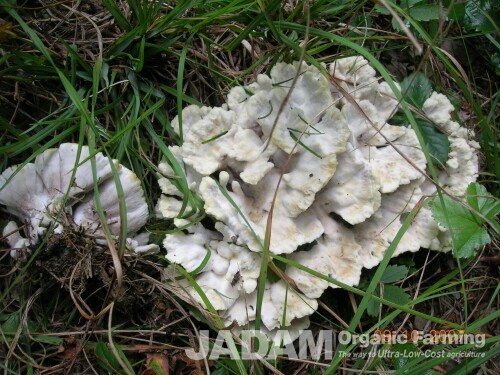
Members of the genus Albatrellus, such as the sheep polypore (Albatrellus ovinus) which lacks gills and possesses pores, the fused pellicle (Albatrellus confluens) (Alb. & Schwein.) Kotl. & Pouzar, and the crested polypore (Albatrellus cristatus) (Schaeff.) Kotl. & Pouzar (provisional name), are exceptional in that they grow on the ground rather than on dead wood, and their tissue is soft rather than woody. In particular, the sheep polypore has a soft texture and a good flavor similar to oyster mushrooms, and it is even harvested and sold commercially in the wild in the western United States. The species name ovinus means "related to sheep," likely given because of its white color. Therefore, its Korean name is Yang-teol-bang-pae-beoseot (woolly shield mushroom) and its English common name is sheep polypore. This mushroom is currently receiving great spotlight due to its excellent medicinal properties.
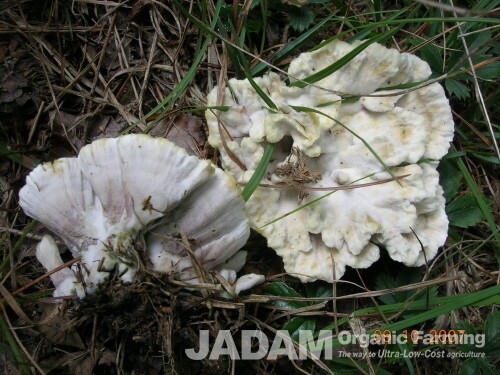
Members of the genus Albatrellus have the property of absorbing and accumulating nickel. According to a study conducted near industrial complexes in Sweden, 1 kg (approx. 2.2 lbs) of these mushrooms absorbed and accumulated 0.72 mg of nickel. Furthermore, they also absorb and accumulate selenium. Thus, Albatrellus species can be used as environmental monitors (Rogers, 28).
The sheep polypore contains carboxyl esterase, an enzyme that hydrolyzes esters, as well as protease (a protein-degrading enzyme) and amylase (an enzyme that saccharifies starch). Protease is used in cheesemaking, tenderizing meat to add flavor, and in treating blood clots (thrombi) and inflammatory diseases. Amylase is used for digesting starch and in the production of cosmetics and alcohol, as well as in detergents, wood pulp bleaching, laundry—especially for leather and fur—and even in the production of food and feed products (Rogers, 28).
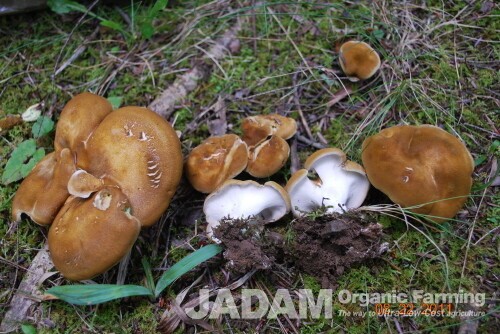
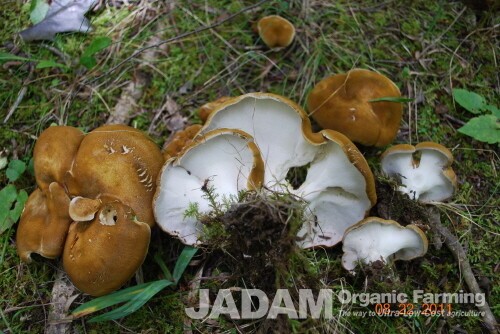
Among the Albatrellus species, the crested polypore (Albatrellus cristatus) grows extensively in eastern North America, from New Brunswick in the north to Florida in the south, and as far west. The author also encounters it frequently, specifically discovering a large quantity on the ground near oak trees in August 2011. This crested polypore contains grifolic acid.
Medicinal Use
Albatrellus mushrooms contain grifolin and neogrifolin, which are cholesterol defense substances and strong antioxidants produced by the fungi. These substances are said to prevent the absorption of cholesterol from food into the body rather than lowering existing cholesterol levels. Additionally, they contain excellent chemical components for medicinal use, such as antibacterial, anti-inflammatory, and anticancer agents. They also contain scutigeral, the antibacterial substance ilicicolin B, ovinal, ovinol, and grifolic acid (Rogers, 28).
Polysaccharides from the mycelium of Albatrellus show a 100% inhibition rate against Sarcoma 180 and Ehrlich cancer cells, and are reported to have inhibitory or reductive effects on various other types of cancer cells. For example, they inhibit or reduce cancer cells such as nasopharyngeal, cervical, breast, colorectal, leukemia, Burkitt's lymphoma (common in African children), and marmoset B lymphoblastoid. Furthermore, grifolin inhibits or reduces osteosarcoma cancer cells (Rogers, 28).
They are also effective in treating painful diseases such as rheumatoid arthritis, septic shock, and inflammation caused by the excessive secretion of nitric oxide (Rogers, 29).
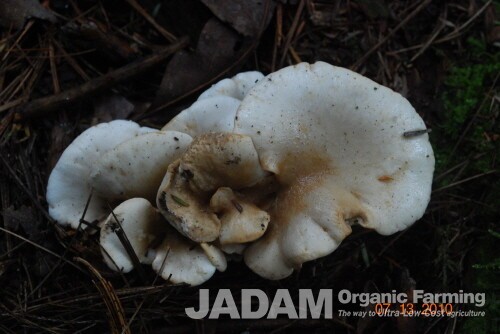
Lipase (a type of esterase that breaks down fats) and carboxyl esterase found in sheep polypore are not only important components for the food manufacturing mentioned above but are also useful for sewage treatment, pulp and paper manufacturing, oil degradation, and the production of biodiesel made by mixing vegetable oil with diesel (Rogers, 30).
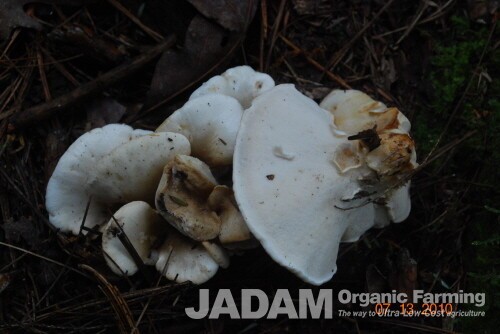
According to Park Wan-hee’s Medicinal Mushrooms of Korea, the crested polypore (Albatrellus cristatus) contains cristatic acid, which has antitumor and antibacterial pharmacological actions (Park Wan-hee, 674). In any case, Albatrellus species are important mushrooms whose pharmacological effects have recently drawn attention, and several species, including the fused pellicle, grow in Korea.
Q: Is the sheep polypore edible and what are its main health benefits?
A: Yes, the sheep polypore is a choice edible mushroom with a texture similar to oyster mushrooms; it is highly valued for its ability to prevent cholesterol absorption and its potent anti-inflammatory and anticancer properties.