

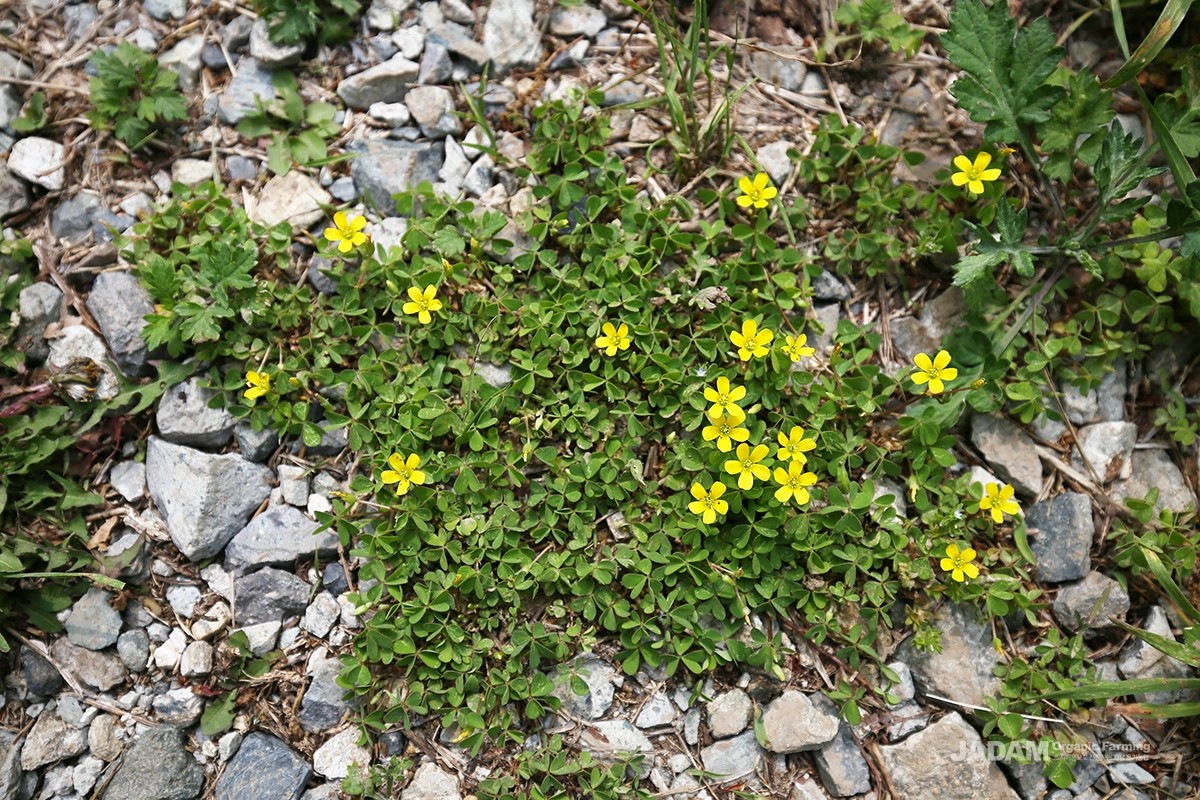
A perennial herb commonly found in sunny fields, orchards, and roadsides. In spring, multiple stems emerge and grow obliquely in all directions, blooming yellow flowers sequentially over a long period until summer.
Creeping woodsorrel (Oxalis corniculata) is a perennial herb that grows commonly in sunny fields, roadsides, and empty lots. In the spring, several stems emerge and spread obliquely in all directions. It typically stays low, reaching a height of only 10 to 20 cm. However, because the flowers are quaint and attractive, people often leave them be; if left unchecked, the plant sends tough roots deep into the ground and rapidly expands its territory with vigorous reproductive power.
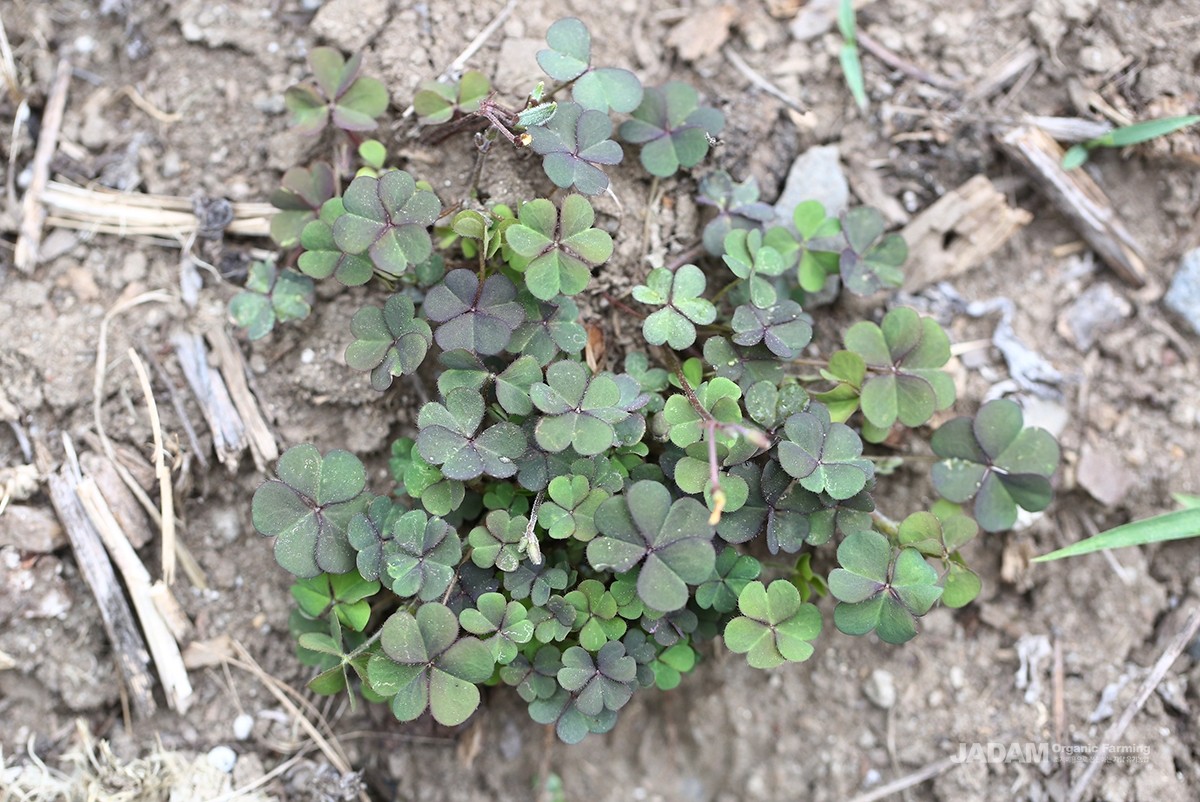
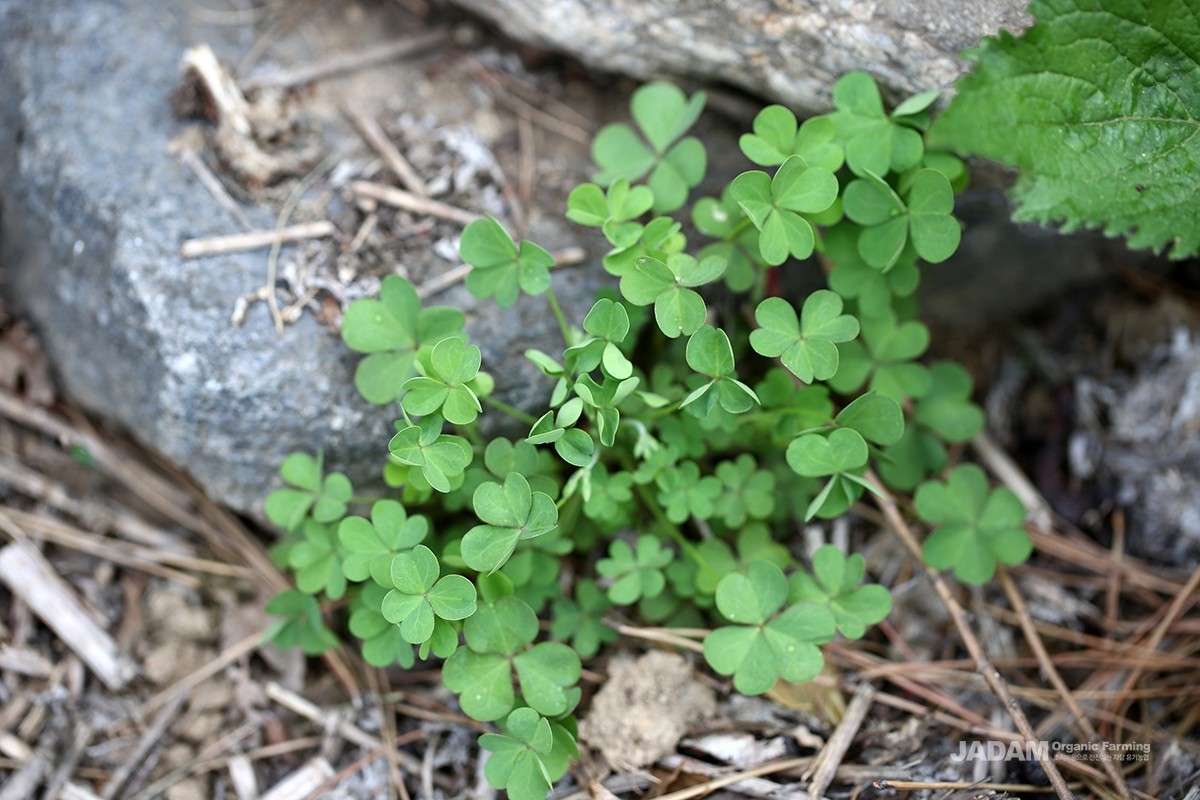
The foliage consists of compound leaves, each formed by three heart-shaped leaflets. These leaves have long petioles and are arranged alternately on the stem. When the weather is cloudy or darkness falls, the leaves fold up. The leaves contain a significant amount of oxalic acid, which gives them a sour taste. This is a defense mechanism the plant uses to protect itself from insects that might try to eat its leaves.

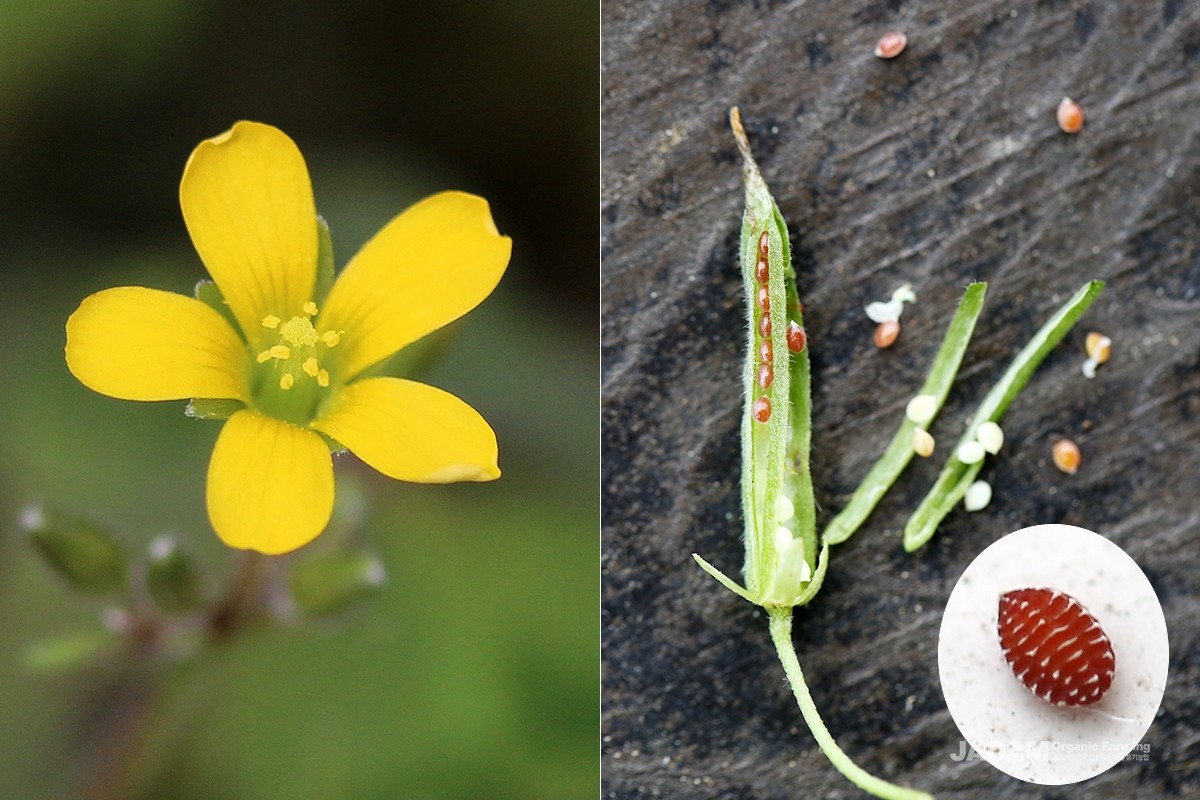
From spring through summer, long flower stalks emerge sequentially from the leaf axils, each tipped with 1 to 8 yellow flowers. The flowers have five petals that are obovate (egg-shaped) in form. Like the leaves, the petals close when it becomes cloudy or dark. The flower has ten stamens—five long and five short—and five styles. The fruit is a cylindrical capsule that grows pointing upward.
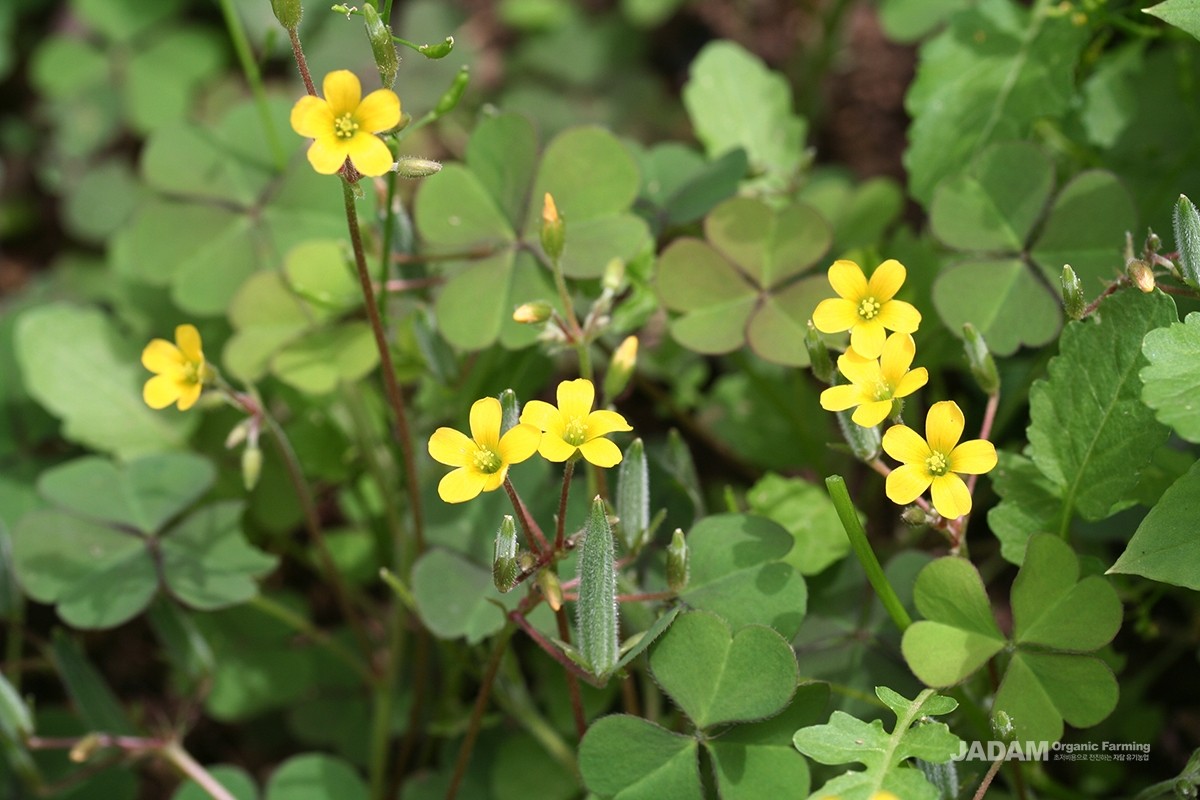
The fruit is structured with five chambers (locules), resembling a carton holding eggs, where the seeds are stacked neatly. The inner skin of the fruit grows faster than the outer skin, causing pressure to build up inside. When the seeds are fully ripe, the skin eventually splits, and the built-up pressure causes the seeds to burst out. The seeds are slightly flattened and egg-shaped, with a pointed tip, and are brown with fine wrinkles.
▶ Utilization and Medicinal Properties
The tender leaves can be eaten raw, or blanched and seasoned as namul (a traditional Korean seasoned vegetable dish), or added to salads and bibimbap (mixed rice with vegetables). However, because oxalic acid—the main component responsible for the sour taste—can bind with calcium in the body to form stones, it is not advisable to consume large quantities raw. Medicinally, it lowers body heat, removes dampness, and possesses antibacterial properties, making it effective for summer stomach aches or diarrhea. It is used to treat diarrhea, dysentery, jaundice, hematemesis (vomiting blood), sore throat, rectal prolapse, hemorrhoids, and scabies. The taste is sour, and its nature is cold.
▶ Control Methods
Because of its short stature, creeping woodsorrel does not pose a problem in orchards. However, due to its prolific reproductive ability, it is best to remove it during the early stages of growth if it appears in greenhouses or crop fields.
▶Etymology and Similar Species
The Korean name Gwaengibap literally translates to "Cat's Rice," derived from the observation that cats chew on this grass to aid digestion when they have a stomach ache or diarrhea. Due to its sour taste, it is also called Chojangcho (Vinegar Herb) or Sigeumcho (Sour Herb). A similar species, the common yellow woodsorrel (Oxalis stricta), has stems that grow upright rather than spreading along the ground. Among the ornamental varieties with purple flowers, the pink woodsorrel (Oxalis articulata) features underground tubers and yellow anthers, while the violet woodsorrel (typically referring to Oxalis corymbosa in this context) lacks tubers and has white anthers.