

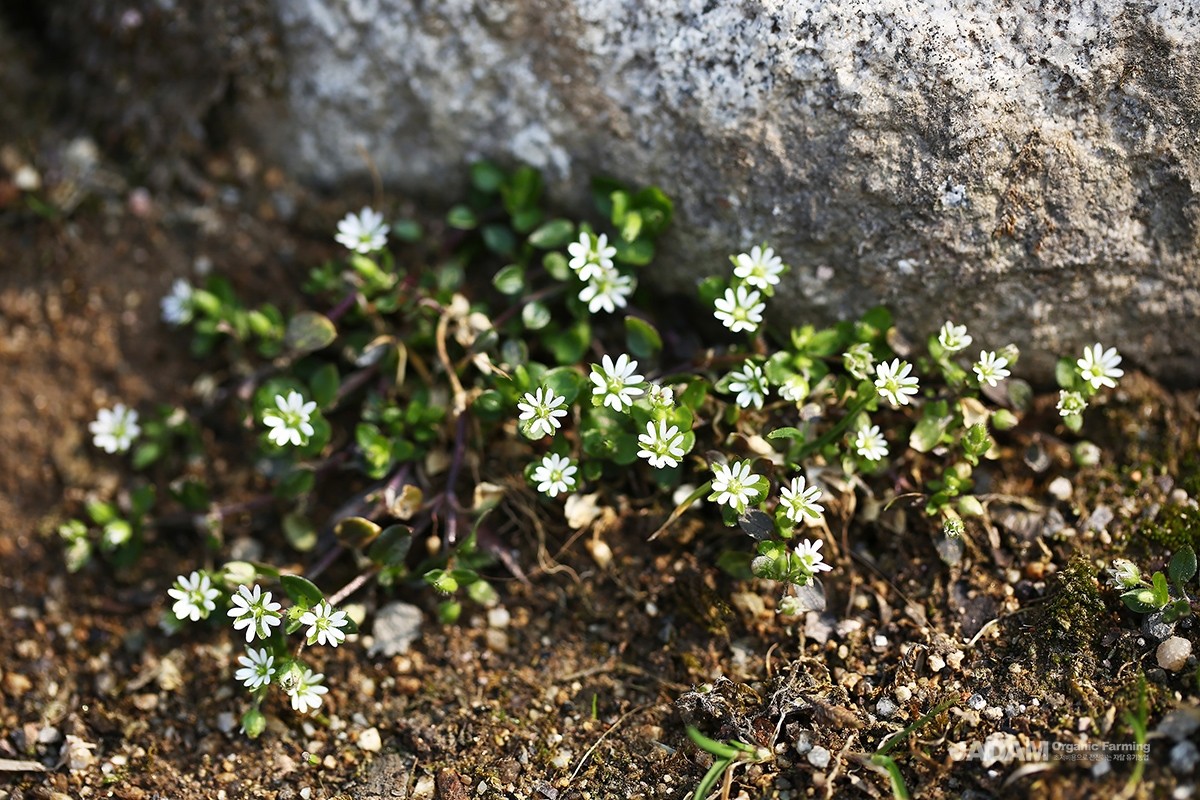
It is a winter annual herb commonly found in fields, orchards, rice paddy edges, and roadsides. It overwinters in a rosette form and produces small, star-shaped white flowers from early spring.
Chickweed (Stellaria media) is a winter annual herb in the pink family, commonly found in fields and roadsides. In sunny places, multiple stems emerge in winter and creep along the ground, spreading in all directions. The plant grows up to about 20 cm tall. The leaves are opposite, egg-shaped, and smooth-edged, with the lower leaves having long petioles and the upper ones short or none. Both leaf surfaces are hairless.
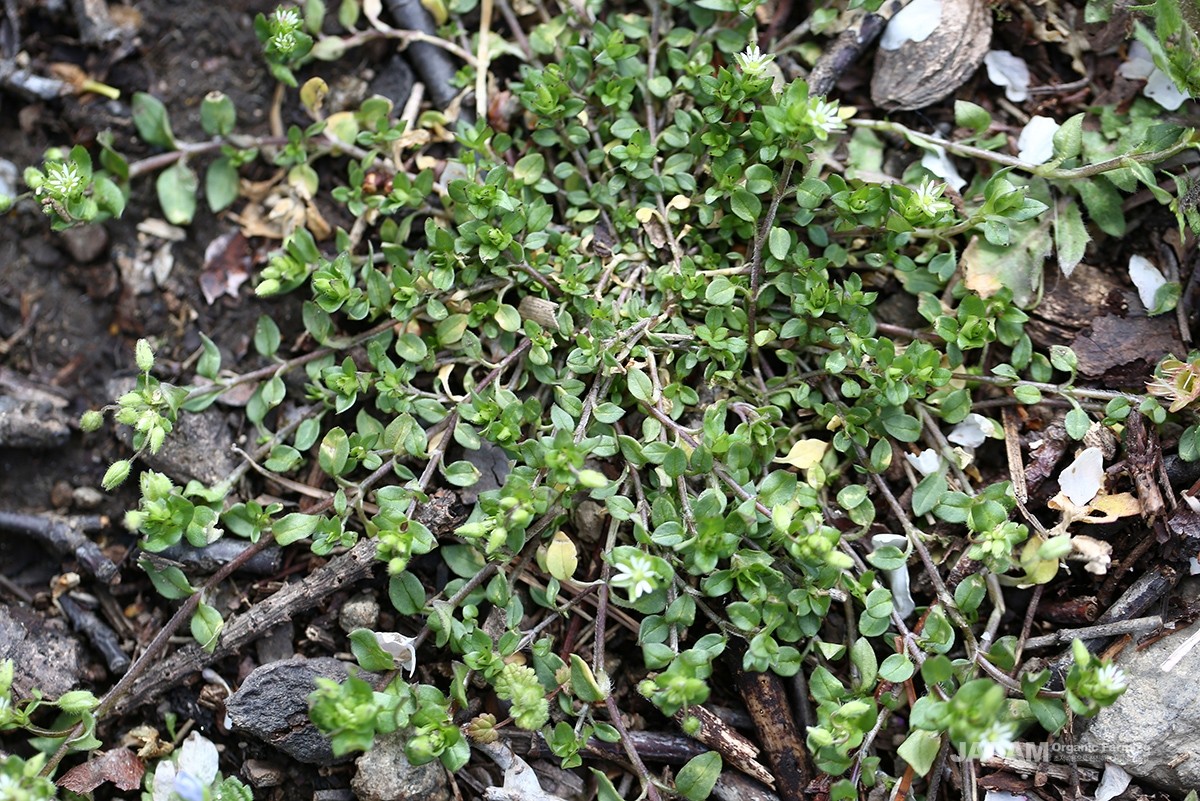
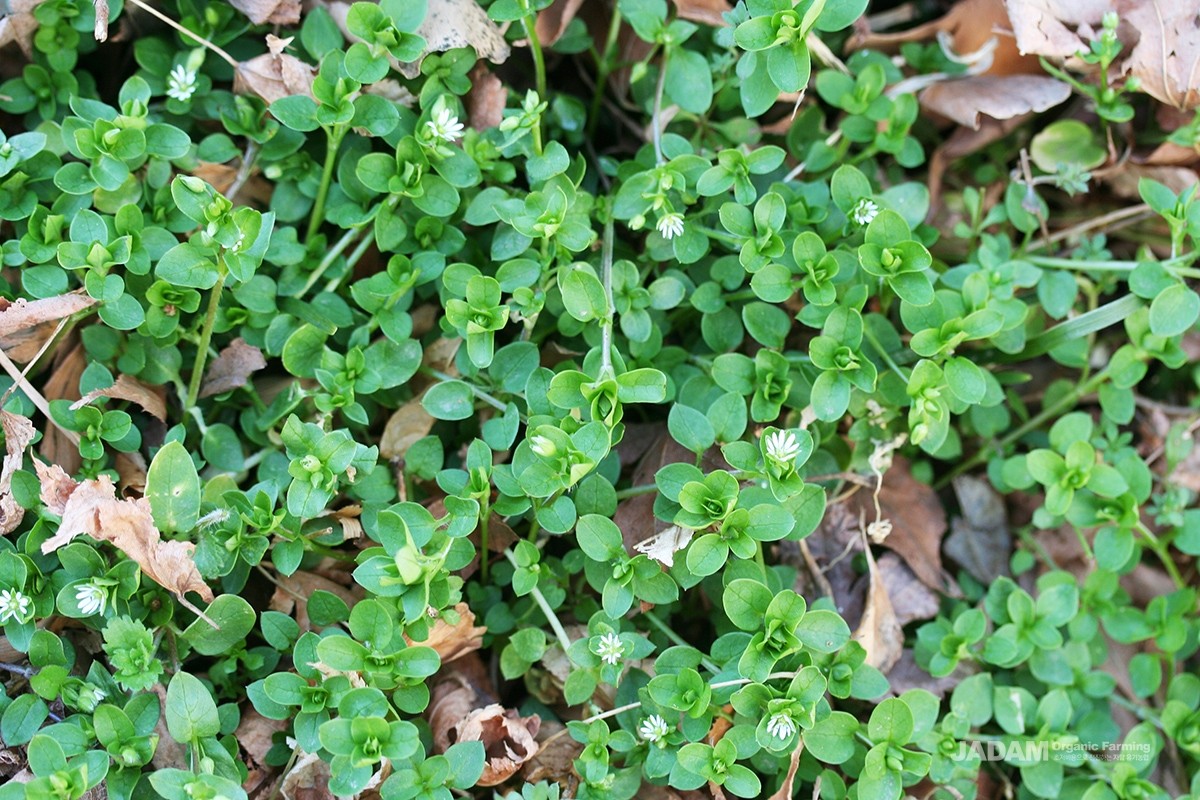
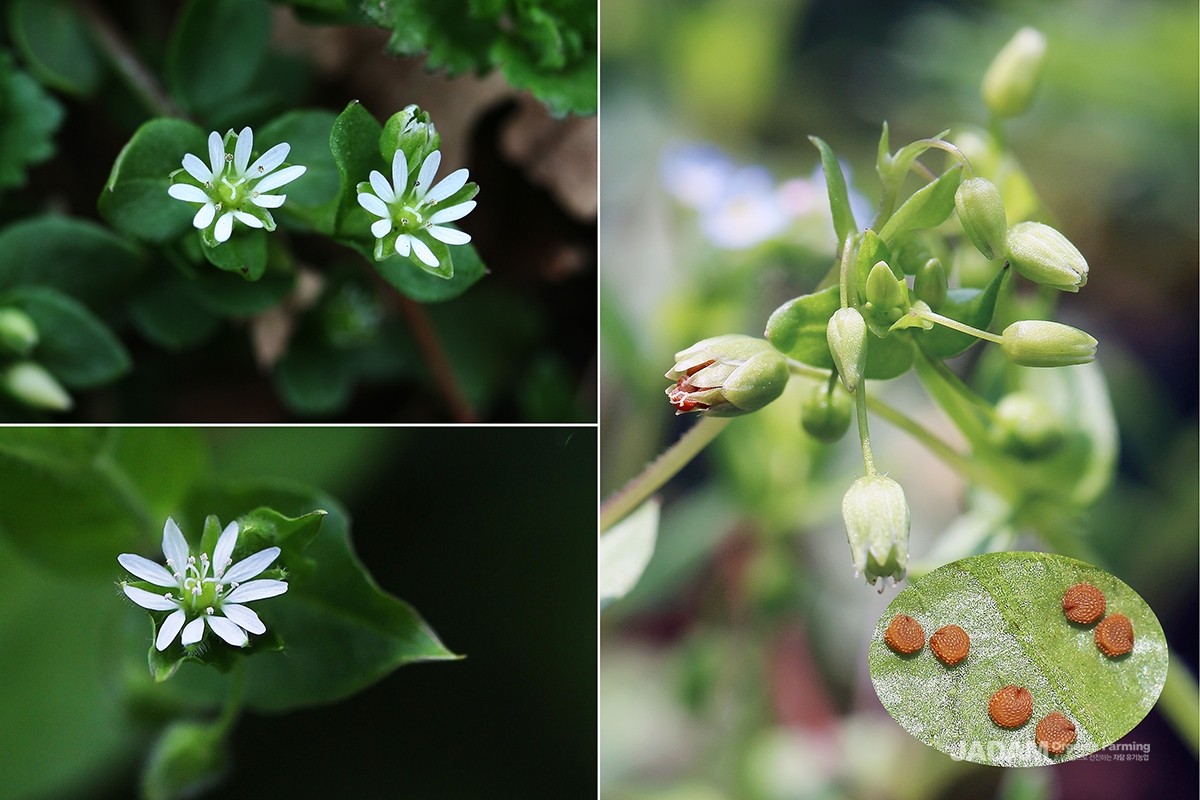
From early spring, small white flowers bloom in cymes at the tips of the stems. The flowers have five sepals densely covered with glandular hairs on the back. Although the flower has five petals, each one is deeply divided like a rabbit’s ear, making it appear as if there are ten. When viewed under a magnifying glass, the flower looks like a tiny star-hence its Korean name “Byeolkkot,” meaning “star flower.” A single plant produces hundreds of these tiny blossoms throughout spring.
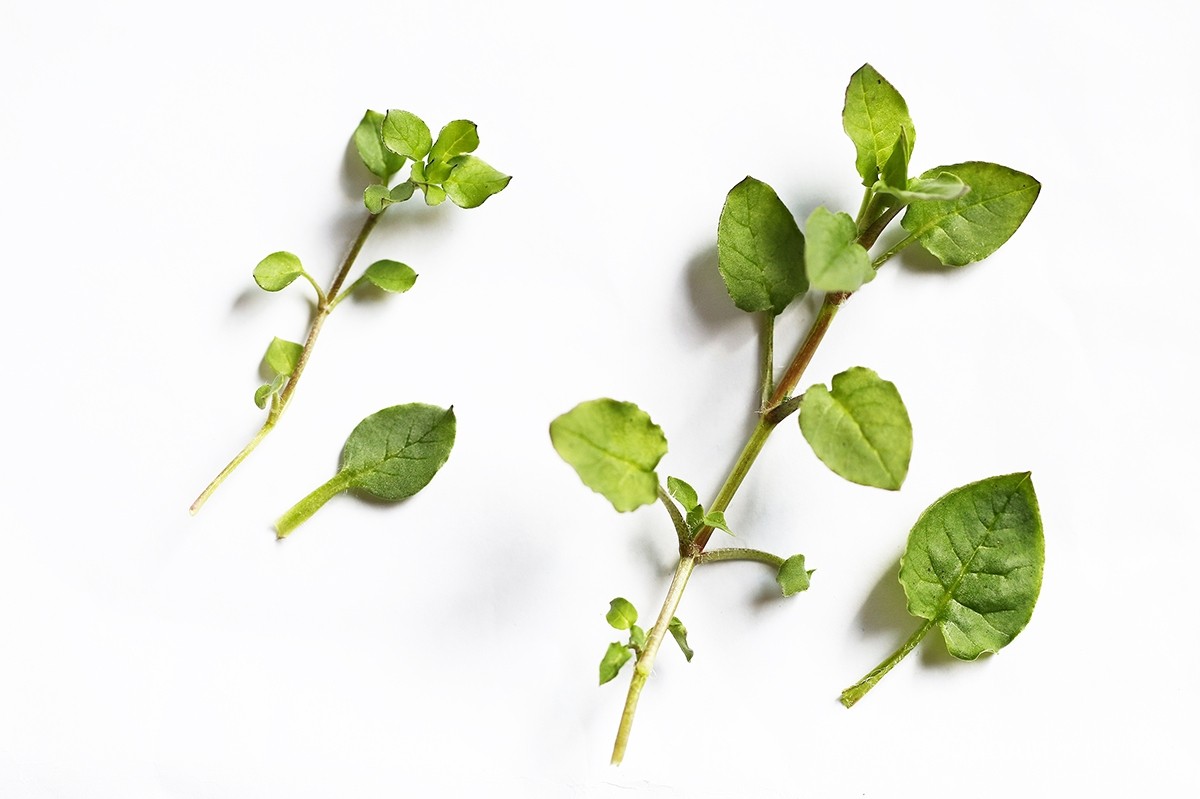
Each flower has three stigmas and five stamens. The flowers contain nectar, attracting small insects such as hoverflies for pollination. However, if no insects visit by evening or on cloudy days, the petals close, and the flower self-pollinates-a strategy common among annual weeds to ensure seed production.
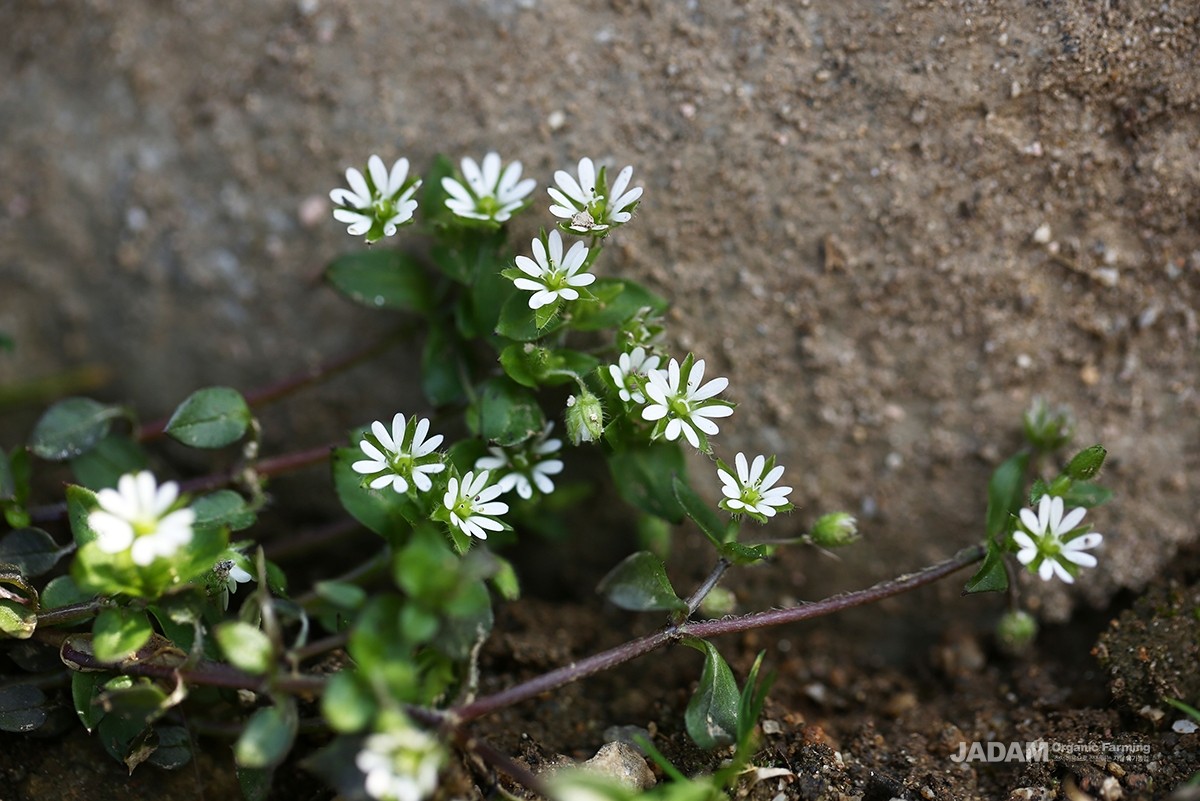
After pollination, the flower bends downward as the fruit matures, then lifts again when ripe. The fruit is an egg-shaped capsule that splits open at the top, revealing reddish-brown seeds covered with tiny warty projections. These rough surfaces help the seeds attach to soil particles or the feet of animals, aiding their dispersal.
▶Uses and Medicinal Properties:
In spring, the young shoots can be eaten raw in salads, lightly blanched and seasoned, or added to soybean paste soup. Its juice or powder mixed with bamboo salt can be used to rinse the mouth and relieve gum inflammation or bleeding. It promotes blood circulation, removes stagnation, and enhances lactation. The taste is slightly sour, and its nature is neutral.
▶Control:
Since the plant is short and not very dense, it causes little problem in orchards. However, in vegetable fields or greenhouses, it is best to pull it out while young or before the flowers wither and the seeds scatter.
▶Name Origin and Similar Species:
The Korean name “Byeolkkot” means “star flower,” referring to the star-shaped blossoms. The closely related Stellaria aldine (Greater chickweed) has spade-leaves, five branched stigmas, and ten stamens.