

The Mysteries of Wild Mushrooms
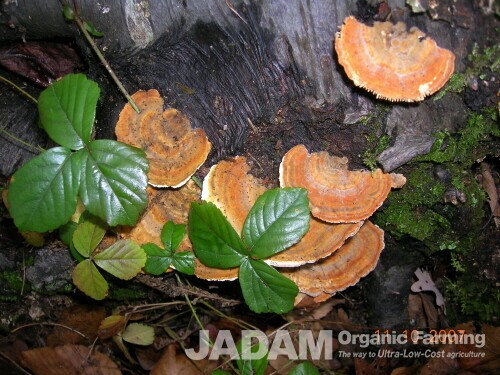
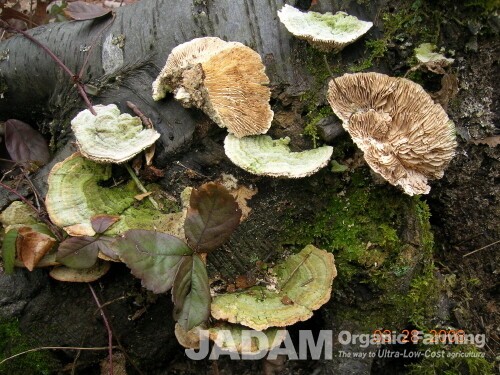
Birch Mazegill (Gilled Polypore). Scientific name: Lenzites betulina. English name: Gilled Polypore. The cap is 2-13 cm in size, nearly circular or generally fan-shaped to shell-shaped. It is densely covered with short, velvet-like hairs and features concentric zones of grayish yellow, yellowish-brown, or orange colors. Old specimens may have green moss growing on them. The flesh is leathery. Its external appearance is exactly like that of polupore, but because it has gills, it was given the English common name “Gilled Polypore.” The species name betulina comes from betula, meaning birch tree. This mushroom was also photographed growing on a dead Black Birth stump. It grows on dead broadleaf trees throughout summer and autumn. Specimens found in the Eastern United States are characterized by orange or yellowish-brown colors, as seen in this photo, while those in Korea and the Western United States tend to be grayish-brown. This mushroom found in the Eastern US is easily confused with the Korean Daedalea dickinsii (Maze-gill). It is reportedly used for medicinal and industrial purposes, treating paralysis of the hands and feet and arthritis, and is used in dyeing, bleaching, or paint manufacturing (Wanhee, Park)
Regardless of whether they are biological, microbial, or abiotic, everything existing in the universe has a reason, meaning, and value for its existence. However, we tend to think from a human-centric perspective, valuing things as precious or dismissing them as bad depending on whether they bring us benefit or harm. Among existing things, there are those we call weeds. Because they are considered harmful to farming or detrimental to the beauty of a garden, they are regarded as very troublesome. We try to pull them out as soon as we see them, and sometimes we spray chemicals with formidable power to eliminate them. Must weeds be harmed in such a reckless manner?
In the Eastern United States, all sorts of bugs begin to fly around outdoors starting in April when the sunlight is good. Although not mosquitoes, bugs resembling mayflies fly around in large numbers and stick to the human body; once bitten, it itches terribly. Also, if bitten by strong mosquitoes in the summer forest, one suffers from itching for about a week. Although not common, people occasionally get stung by bees. Is there no way to administer first aid when bitten or stung by poisonous insects outdoors without any special medicine on hand?
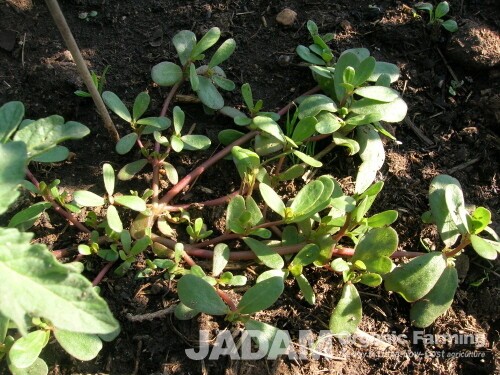
First of all, it is convenient to know three or four types of herbs that can be used as medicine. The most easily obtainable ones near human habitation are Purslane (Portulaca oleracea) and spotted Spurge (Euphorbia maculata). Purslane is a plant commonly classified as a weed that grows creeping on the ground near roadsides, flower beds, or vegetable gardens. Its leaves are small and round, and like moss rose or stonecrop, it is a succulent plant containing a lot of moisture. When we were young, we used to pull up this plant and sweep its roots with two fingers chanting, “Light the groom’s room, light the bride’s room,” and the roots would turn red as if lit up. When stung by a bee or bitten by a mosquito, if you immediately find this Purslane, pick a stem, crush it with your hand to extract the juice, and apply it to the affected area, the swelling and pain will miraculously subside within 30 minutes.
I once heard news on a morning broadcast that a truck carrying honeybees dropped beehives on a highway near Philadelphia, causing bees to scatter in all directions. As it happened to be a Sunday, I bought lunch at McDonald’s and went for a brief picnic. Bees flew in from somewhere and stuck around the soda cups. I had completely forgotten about the morning news. The moment I put my hand in my pocket to take out the car keys after lunch-ouch! A bee that had crawled into my pocket stung my finger. The pain was so severe that the stung finger felt numb. I shouted immediately. “Quick, find some Purslane!” Luckily, I found Purslane in the picnic area, crushed it with my hand, and applied the juice to the stung finger. The pain subsided immediately, as if I had never been stung, and I was able to get by with just a little itching for two or three days.
It happened when I went to Merida on the Yucatan Peninsula in Mexico to give a lecture. After finishing all the lectures, on the way to the missionary’s house who invited us, one of our party got stung by a bee. He was making a fuss about the pain. I looked around near the lecture venue to see if there was Purslane in Mexico, but I couldn’t find any. Upon arriving at the house and getting out of the car, I looked around the house thinking ‘maybe,’ and a plant similar to Purslane caught my eye. I immediately gathered the plant, crushed it, and applied it to the arm of the person stung by the bee. Since there was no medicine anyway, there was nothing to lose. Afterward, he forgot that the stung area was even painful.
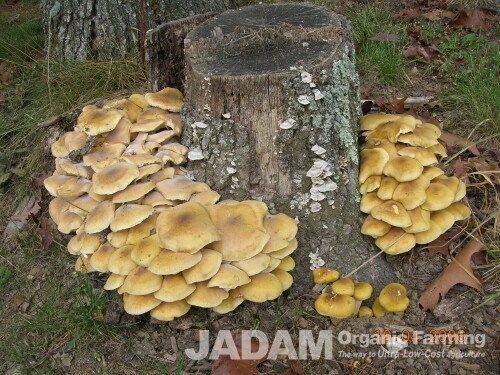
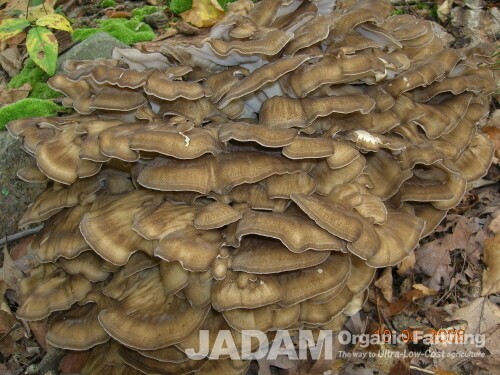
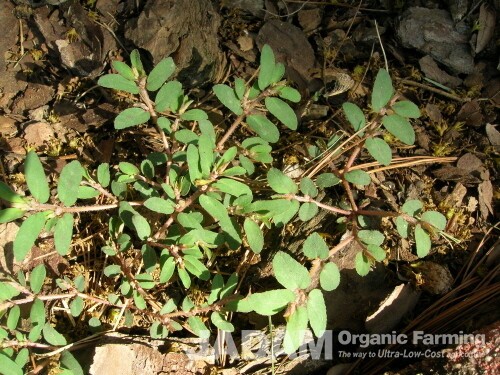
October 4, 2006. It was a very lucky day, and I was able to harvest three or four baskets of perfectly grown Honey Mushrooms (Armillaria mellea), as well as three or four clumps of Hen of the Woods (Grifola frondosa) (Hen of the Woods clumps are usually large enough to fill a basket). While I was excitedly harvesting Honey Mushrooms, mosquitoes attacked and stung my fingers and wrists mercilessly. However, no matter how much I searched the vicinity, I could not find Purslane. Just then, I remembered reading in an article about medicinal weeds a few days ago that the milk-like sap from Spotted Spurge is effective when applied to insect bites. Since it was on a mountain, there was no Purslane, but while looking for Spotted Spurge, I found it creeping extensively on the ground even though it was dry from drought. I tore off a couple of stems here and there on the mosquito bites. Although it was a bit sticky, the itching strangely disappeared. This Spotted Spurge grows even in cracks in cement near houses or roadsides, spreading very flat and long on the ground, and its leaves are round and about the size of a bedbug. If you gather the stems spreading flat on the ground to pull them out and eliminate them, the stems often break and release white milk. If this milk gets on your hands, it is very sticky. However, this milk is effective when applied to insect bites.
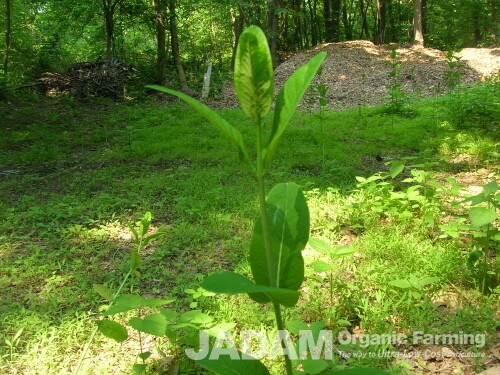
Among the weeds that produce white milk like the latex of Spotted Spurge, there is a grass with the English common name Milkweed. This plant grows quite tall, some reaching up to an adult’s chest. When it is difficult to find other plants, the latex from the stem of this plant is also effective when applied to insect bites. This latex is also sticky when applied.
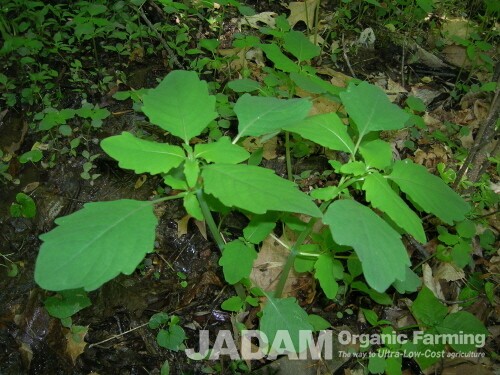
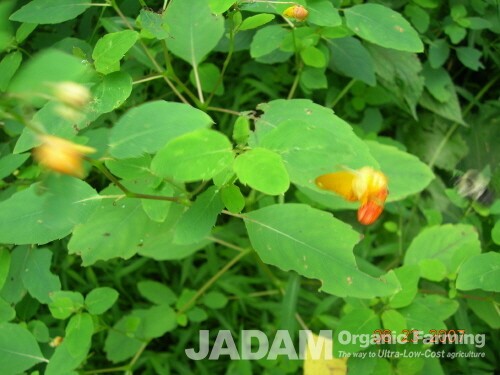
Furthermore, the most easily accessible plant near the water in the forests of the Eastern United States is Jewelweed. Similar to the garden balsam found in Korea, touching its seed pods causes them to burst open and eject their seeds. It is a succulent plant that grows lushly in any low-lying, moisture-rich area near water. Some grow taller than a human, and the thick stems can exceed the width of a thumb. It blooms with yellow or orange flowers in the summer, with the yellow variety being the most common. As soon as I enter the forest to observe mushrooms, I make it a priority to pick a stem of this plant from the waterside and carry it in my mushroom basket. Although I apply mosquito repellent spray, this serves as a first-aid measure in case I do get bitten. You can also harvest some of these plants, add a small amount of water, and boil them thoroughly to extract a yellow liquid. This extract can be stored in the refrigerator and applied to mosquito bites.
The fact that plants we dismiss as annoying weeds can serve as such excellent medicine compels us to deeply reflect on our attitude toward all things in nature. This is why one author, while wrongfully imprisoned, cultivated a flower garden using so-called “weeds” and, after observing them closely, argued that they should not be called weeds. (Hwang, 2002).